The Spirit of the Written Word
Sumer was one of the first civilisations on this planet. It had existed since before the 25th century BC in what is current day south of…
Sumer was one of the first civilisations on this planet. It had existed since before the 25th century BC in what is current day south of Iraq. In Sumer, there was once a king named Urukagina who was crowned when the kingdom was stooped in corruption and inequality. He considered it his divine duty to save his people and fix his kingdom. He brought in numerous reforms to fight corruption and had them set in stone, literal stones. For the first time in recorded history, he had the concept of “freedom” written down. Over centuries, Urukagina’s name was lost in an ocean of worlds, civilisations, wars and general human misery. But his written records were rediscovered and given his name — Urukagina’s code. They are now considered the oldest records of attempts at governmental reform.
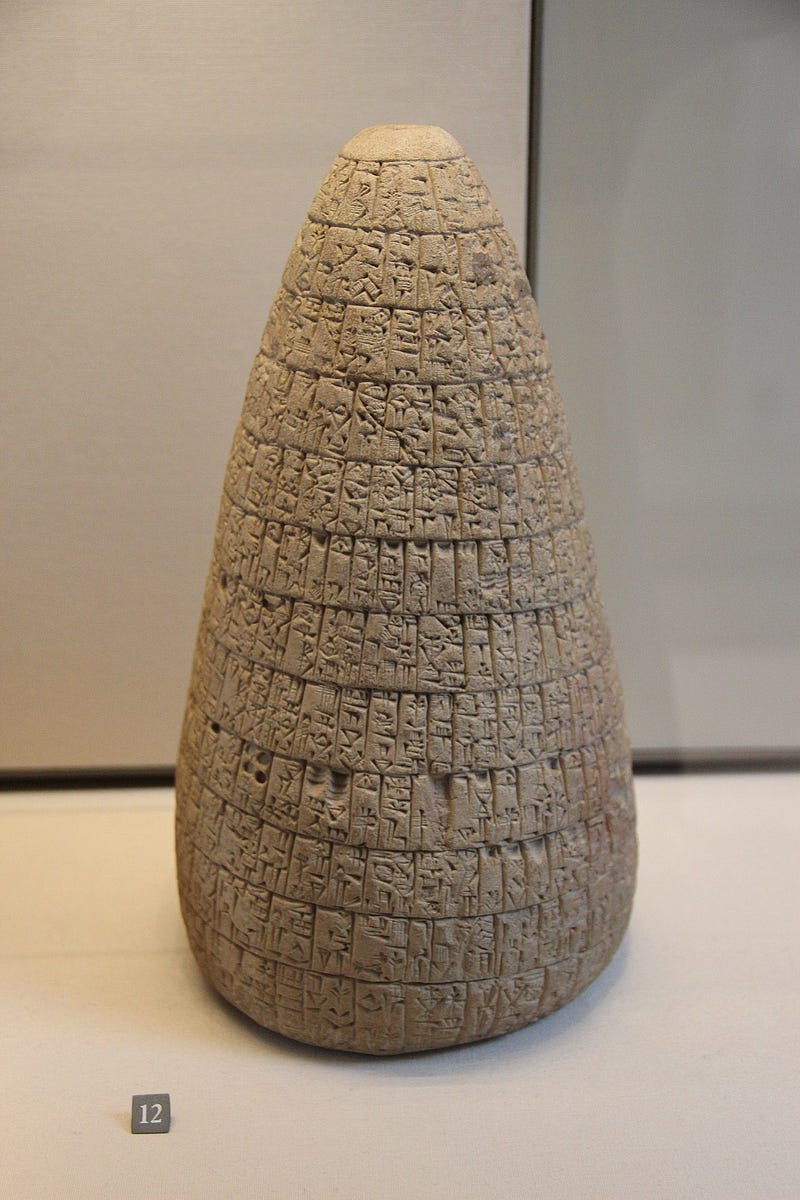
Humans always have an urge to leave a part of themselves behind. To immortalise themselves in their legacy. The entire plot of Iron Man 1 was Tony Stark questioning himself what the legacy of his name is going to be.

It is a primal urge for immortality, no matter what form it takes — to know that you left a footprint in the world that no one could erase. We study, we build things, we perform, we create art, we design. All in the hope that the result will survive time and will be known years, decades or centuries later. And this is how we immortalise ourselves through the things we create.
We are living in an age of innovation and technological advances. New technologies and devices and scientific studies and products are coming up every single day. We are benefitting from close to 8 billion people thinking about problems and demanding for better solutions. Businesses are sprouting everywhere, ready to build solutions one problem at a time. People are coming together in groups ranging from 3 to 300 in size to work on a solution. Successful solutions grow in size and expand their solution. Unsuccessful solutions pivot and work on a different problem. Every group is learning from each other’s failures and working iteratively on better solutions. Sustainable growth has always depended on learning from mistakes. And those learnings are passed from one human to another. What matters is how are they passed forward?
Before paper was invented, and before humans figured out a written system, word of mouth was the primary mode of communication. Each person was essentially a data repository and if you want a piece of information to survive, you had to make sure that repository was backed up in another human’s brain or else you had to go out for the hunt of that piece of information again. This works for a few centuries, but as your civilisation grows and the amount of information increases exponentially, those small human brains reach their capacity. You need a better form of communicating to a much larger population. Enter written word.
Writing provides humans the power to replicate a piece of information as well as sustain it across time and space. Writing has two parties to it — the Writer and the Reader. The Writer is the one attempting to disseminate information and the Reader is going to consume the information. With writing, a Writer could be sitting in 16th century France and communicating their ideas about life and death to a Reader reading it on their e-reader in the 21st century. A single Writer can influence millions of Readers with their writing within a span of a year.
And this is why you write when you build something. To communicate what you thought, what you implemented, what you did not think, what you couldn’t implement, why you implemented it in the way you did. This applies to any field — science, history, arts, engineering, design, anything at all. When you document your knowledge, you ensure a piece of your life that will outlive you. When you work in a team, and you write down your ideas, and you spread it out in the team, two things happen —
- You are able to put forward your own perspective on a certain topic. It could be a particular design choice, an algorithm you implemented, a design pattern you thought would help, a product feature that you think would be beneficial. All from your own perspective.
- You allow your team, the Readers, to develop their own perspective on the topic by giving them the time and pace to go through your opinion at their own leisure. This means that you’ll have more heads pitching in your idea than some heads shaking to everything that you explained to them in one meeting.
Putting down words on paper has a direct benefit to the Writer as it forces them to structure their thoughts and give a meaning to it. It allows the Writer to explore areas of that particular thought that they hadn’t hit upon until now. When you divide your page into introduction, the why, the how and the end, you give your idea a shape that everyone can understand and explain to one another.
A Writer has the responsibility of looking at the audience of the Reader and shape the idea into a form that is relevant to the Readers. A developer cannot give the same root-cause summary to an engineering team and to a managing team. A teacher cannot present calculus to students in two different grades in the same way. Knowing your audience is paramount for the Writer. The added advantage of this is that the Writer gets an opportunity to empathise with different groups of Readers and understand their perspective. Some of the best user guides are written when the Writer is writing for the user and not for the creator.
But all of these points are moot if the Writer does not have the spirit to document. And that spirit is found only when you have the conviction to believe that what you build shall survive and that your legacy (no matter at the end of your life or at the end of a stint in a company) shall be the knowledge you gained from all the experiences you had. If you are building something right now, write about it. Let people know and let people read. Document your thoughts, ideas, opinions and let them spread where your voice cannot. There cannot be a better opportunity for this than the Age of Information.
Just write. Like the king of Sumer once did. For freedom. Of knowledge.